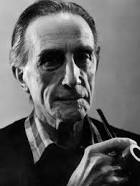
| | Dada Perfume:
A Duchamp Interview
Making Mischief: Dada Invades New York at the
Whitney through February 23, 1996 | | by John Perreault | JP. It
has been a long time since we had one of our little conversations. They used to mean so much to me.
Marcel Duchamp: 1964? Bob Rauschenberg brought you by, thinking
you could play chess. JP: I can, but I hate it.
Besides, I think it was Jill Johnston. I know it wasn't Jasper, because I never really knew him and I didn't meet John
Cage until much later, actually, in the South Pacific. A lot has happened since I first met you. MD: Particularly to me. JP: We needn't go into that. MD: It is kind of embarrassing. I used to say that what happened to me only happens to others.
JP: Not to belabor the point, but I remember that when I first
met you, which was at the beginning of my career as an art critic, and the so-called end of my career as an artist, and
almost the end of my career as a poet, you insisted that the true artist had no choice but to go underground. Now you
are truly underground. MD: Very amusing.
JP: Not as amusing as your last art work Given: 1.
the waterfall. 2. the lighting gas. Very few knew about that tableau until after it appeared
at the Philadelphia Museum of Art among your other masterpieces. MD: My gift to the art world. JP:
Why did you keep it a secret? MD: As we have
discussed in the past, secrets have been essential to my work, which may or may not have anything to do with art.
JP: I read in Calvin Tomkins' new biography called simply Duchamp (Henry
Holt, 1996) that your brother-in-law Jean Crotti once said that how you used time was your real art work.
MD: Rather, it was how I abused time. JP: For me your main contribution has been your secretiveness. And this inspired my own Secret Artworks.
I'd say that that secrets are certainly a theme in your work. I think of the 1916 Readymade called With a Hidden
Noise which is a ball of string with something inside of it that makes a noise when you shake it. What causes
the noise? And the work, which I think is magnificent, is not Given itself -- the barn door with peepholes and the nude and the waterfall beyond
-- but that it was kept a secret all
the time you were working on it from 1946 to 1966 and beyond, until it was unveiled. Also, as I pointed out in print years
ago, your output after the Bride Stripped Bare . . . when you were supposed to have given up art for
chess in retrospect has proven not insignificant. Now when you look at the work, much of which is at the Whitney now in
Francis Naumann's exhibition called Making Mischief: Dada Invades New York, it looks as if you were quite
busy between chess games. The work was always there, but invisible, somewhat like Poe's purloined letter in that famous
short story: hidden but in plain sight. MD:
I always kept busy in a mental way. JP:
Was that mental activity art? MD After
a certain point I lost interest in making objects or pictures for sale. If you take away commerce and the prattle of critics,
present company excepted, there is something left which may be art or something else. JP: What is that something else? An idea? You have had an enormous influence on art that foregrounds
an idea, on anti-object art, on process art, on post-modernism. MD: No, not an idea. A rumor, a perfume. JP: Yes. A perfume. You once said that art had a smell that only lasted thirty years. And in the interview I published
in the East Village Other in 1965, I quoted you as saying that art left a scent behind, even when it
was removed to another room, another state, another country. MD: One of my many contradictory statements, so it must be true. JP: Speaking of contradictions, does the current Whitney exhibition bring back memories? All your
friends are there from the New York Dada period. The Countess, Man Ray, Beatrice Wood. Is there any art scent left in
the objects, drawings, paintings, books? MD:
For me, none at all. All that work is dead. They have passed their thirty years. All the energy has been sucked out of them.
I felt I was looking at work found in an Egyptian tomb. JP: I had a different experience. You still come up as the king-pin, although most of your important work has
always been on view at the Philadelphia Museum of Art all of these years. On the whole, I think the show is worthwhile.
You can see it, and save the train fare to Philadelphia. MD: Nicely put. JP: I did, however,
like the seven paintings by your old friend John Covert, particularly the one of an apple and an apple cut in half. And
the little collection of things by the Baroness Elsa Von Feytag-Loringhoven. It made me go and look up some of her poems.
MD: She was an inspiration to us all. She had absolutely no
fear. Her costumes were her art. And I enjoyed the way she hunted down and tortured poor William Carlos Williams, who had
somehow become the object of her lust. Hadn't you seen her or Covert's art before? JP: Not that I can remember. MD: There. That it explains why they were still alive to you. They have not been seen as much as my works. They
have not been drained of their energy by the public. That explains their present day perfume. Also I am sure you have
guessed by now that the art perfume is sometimes mostly in the nose of the sniffer. JP: True. I also liked the mock-up the Arensberg apartment, where so many salons were held, having
never been there myself. MD: I found it
suffocating. But business is business. Let the legend linger. JP: Can I dare to urge you to be even more personal? MD: I hate being personal, but since I have long admired your avuncular, haphazard approach to art criticism,
I will do my best. JP: This is a dangerous question.
Why did you marry Lydie Sarazin-Levassor? I have been reading about that in Calvin Tomkins' biography of you. I can understand
your relationship with Mary Reynolds, and then your marriage to Teenie, but Lydia, whom you married in 1927, seemed totally
unsuitable. She was overweight, uninterested in art, and not even very rich. MD: Although it would have been very pleasant if she had been as rich as I first thought, I married
her because she was indifferent to art. I now claim the marriage as an art work, a Happening, a Performance, very much
ahead of its time. After all my masterpiece is called The Bride Stripped Bare by Bachelors, Even. My
first marriage extended that theme. JP:
My next very personal question is also about money. We know you kept your expenses to a minimum. But isn't it true that
you became a private art dealer? MD:
There were all these Brancusi sculptures floating around and this and that. One has to make a living. But also remember
that for a long time I made some spending money by giving French lessons. JP: And the Whitney exhibition? Is it true to the period? MD: It is not for me to judge. For me, it is a collection of ghosts; cadavers on a slab; dead meat.
JP: Is there Dada now? MD: The Dada we tried to create has not yet come into existence, probably cannot come into existence.
This exhibition is not Dada, Tomkins' book is definitely not Dada. It might have been better to have added another floor
showing fresh art, art with some surprise in it. JP: The show is educational. It tries to capture a really wild period in American Art. I am not sure that Naumann's
theory that New York Dada, as opposed to European Dada, is humorous, rather than witty. Tomkin points out that the French
word you used, usually translated as "mind," in your famous statement that you wanted to put painting in the
service of the mind, also means spirit, soul, vitality, character and wit. MD: He's right. JP:
The exhibition inadvertently confirms your role as a catalyst. But beyond the time frame of the exhibition, it is now a
commonplace that without you, and without Dada, there would be no Pop, Conceptual Art, and Post-Modern Art.
MD: I take no responsibility. JP: Have you seen any new art that you like? MD: I don't get around much any more. JP: May I recommend an exhibition? MD:
Certainly. I am always interested in what other artists are doing, particularly when they are following up on my ideas.
JP: Just yesterday when I was opening my mail there was a large
format newsprint poster picturing what I thought was your Fountain, the urinal you signed as a readymade in
1917. The poster said Saint Duchamp, and gave the address, which happened to me quite near where I live.
How odd, I thought. MD: And?
JP: It's a brightly lit store front painted stark white and
directly in the window is a rack of novena candles, lit, and to the let a kind of kneeling device from a church with your
Mona Lisa above it. Further inside: Nude Descending a Staircase, Fountain, Bottle-Rack, an unfinished Tu
m', and the two-way door from Paris. At the rear, a door is open revealing a toilet with the lid up. The gallery was
locked. Fortunately, I saw light pouring out of the open cellar door -- it was early evening -- and I walked down the stairs. Inside was a man and three women sitting
around, the walls covered with drawings of Fountain. I was recognized, and they offered to take off their
clothes, because of the painting Alice Neel once did of me nude. I said that wouldn't be necessary. The man remembered
that I had once had a studio in P.S. 122, which is untrue. But then again I recently discovered that there is a young poet
in New Jersey using my name, or pretty close. MD: Don't tell me. The man in the cellar was the notorious Mike Bidlo, who has made Jackson Pollock paintings
and copied everything exactly. Even Andy Warhol. JP: His best show yet. His name isn't even on the announcement. At the risk of adding inspiration to injury, I
would like to add that eight of the sixteen objects by you in the Whitney are replicas, reproductions, reconstructions
or latter-day editions. Bidlo's Duchamps might be seen as replicas of replicas. MD: Well, I always said that a readymade had to consist of something of no aesthetic value and that
is certainly true of my readymades. I think that Bidlo fellow is on to something... JP: Are you still making art yourself? MD: It is one of my bad habits. I am sure there will be more posthumous artworks surfacing.
JP: Finally, since the Whitney show focuses on New York Dada,
what did New York mean to you and your artist friends? MD: Freedom. JP: And what did Dada mean?
MD: Freedom. Copyright ©1996
John Perreault & REVIEW All Rights Reserved |